Marked Down, Signed Up: The Consent Problems Hidden in a Genetic Testing Sale
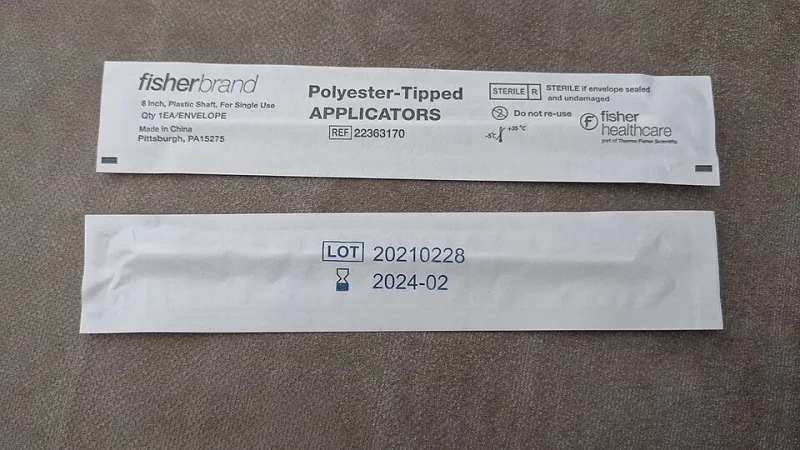
Photo: Donald Trung Quoc Don (Chữ Hán: 徵國單) - Wikimedia Commons - © CC BY-SA 4.0 International.(Want to use this image?)Original publication 📤: --Donald Trung 『徵國單』 (No Fake News 💬) (WikiProject Numismatics 💴) (Articles 📚) 18:17, 8 June 2023 (UTC), CC BY-
Every April, around the commemoration of the completion of the Human Genome Project, a familiar pattern unfolds across American e-commerce: deep discounts on direct-to-consumer genetic testing kits. The same dynamic repeats each holiday season, when ancestry and health testing products appear in gift guides, checkout-page upsells, and two-for-one bundles. These promotions are not incidental to the consumer genomics business model. They are the engine of it.
Yet the regulatory conversation in Washington has focused almost entirely on what happens after a sample reaches a laboratory — data security, law-enforcement access, insurance discrimination — while the moment of purchase remains largely unexamined. That omission matters, because the circumstances under which a person decides to be genotyped shape the legal and ethical quality of everything that follows.
A Decision Made at Checkout
Informed consent, as the term is understood in research ethics, presumes deliberation. A patient considering a clinical genetic test typically meets with a counselor, reviews the implications for relatives, and signs documentation after a cooling-off period. Nothing comparable structures the consumer transaction. A discounted kit bought at 11 p.m. during a flash sale may be activated days later by a different household member entirely, with the terms of service accepted in a few seconds of scrolling.
The economics of promotion intensify the problem. Behavioral research on limited-time offers consistently shows that urgency framing suppresses deliberative reasoning. When a $199 ancestry kit drops to $49 for seventy-two hours, the purchase decision is driven less by an assessed desire to learn one's genetic ancestry than by the fear of missing a deal. The genome, however, is not a seasonal product. The data extracted from a single sample persists for decades and carries implications for children, siblings, and future descendants who had no role in the transaction.
Gifting as a Consent Loophole
Gift-giving compounds the difficulty. A kit purchased as a holiday present is frequently activated by the recipient — but not always. In some documented patterns, family members have purchased kits intending to analyze a relative's DNA, or have swabbed a child or an elderly parent without a full understanding of what enrollment entails. Unlike a sweater or a kitchen appliance, a genetic test generates information about people beyond the person holding the box.
The Institute's earlier work on familial consent examined how a single spit tube implicates an entire kin network. Promotional marketing amplifies that dynamic: buy-one-get-one offers are, in effect, an invitation to genotype two people for the price of one deliberation.
What Regulators Could Reasonably Ask
This is not an argument for banning discounts, which would be both impractical and paternalistic. It is an argument that promotional channels deserve targeted scrutiny under existing consumer-protection authority. Three modest interventions illustrate the space:
First, a disclosure standard for urgency framing. The Federal Trade Commission has a long history of policing deceptive urgency claims in ordinary retail. Requiring that genetic testing promotions clearly state, at the point of sale, that the resulting data is persistent, familial, and difficult to revoke would align the moment of impulse with the reality of the product.
Second, a separation between purchase and activation. Several states have begun to treat genetic data as a distinct category under privacy statutes. A structural safeguard — a mandatory waiting period, or a plain-language consent screen decoupled from checkout — would ensure that the person whose genome is analyzed is the person who chooses to be analyzed.
Third, attention to gifting in state genetic-privacy laws. Statutes such as the Genetic Information Privacy Act model in Illinois address data handling but largely assume an individual, self-directed consumer. Drafters should consider whether gifting and third-party activation warrant explicit provisions.
The Cost of a Cheap Kit
The deeper issue is asymmetry. Companies invest heavily in the psychology of the sale; consumers receive, at best, a dense consent document they are unlikely to read. When the product is a genome, the usual remedy — cancel the subscription, return the item — is inadequate. Deletion requests, even when honored, cannot recall data already shared with research partners, transferred in a corporate acquisition, or matched by a relative's later upload.
None of this requires concluding that promotional pricing is inherently coercive. But a governance framework that scrutinizes laboratory practices while ignoring marketing practices is a framework built around the wrong risk. The cheapest kit a company sells may, in the long run, be the most expensive decision a consumer never meant to make.
The Institute welcomes responses to this explainer, particularly empirical work quantifying the share of consumer genomics enrollment that occurs through promotional channels. Better data on how Americans actually come to be genotyped is a precondition for regulating the moment that matters most: the one before the swab.